 SewMendStitch
Decorating fabric with thread
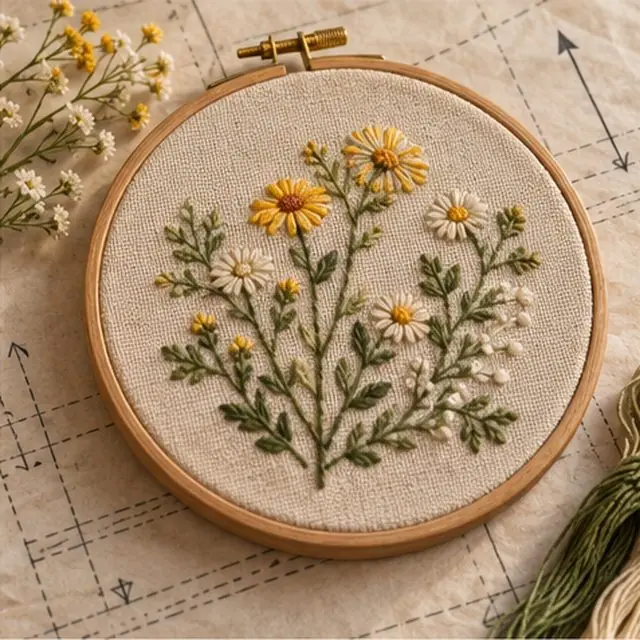
Hand embroidery is decorative stitching worked on fabric with a needle and thread. You draw or transfer a design onto the fabric, then cover the lines and fill the shapes with stitches. The stitches can go in any direction and be any length, so the same flower can be stitched a dozen ways.
You need very little to start: a hoop, a needle, a skein of floss, a piece of cotton and a pair of small scissors.
Embroidery and cross-stitch are different crafts
| Hand embroidery | Cross-stitch | |
|---|---|---|
| Fabric | Any plain fabric, usually cotton or linen | Gridded fabric: Aida cloth or evenweave |
| Design | Drawn or traced onto the fabric | Counted from a chart, square by square |
| Stitches | Many: outlines, fills, knots, loops | Mostly one: the X-shaped cross-stitch |
| Needle | Sharp point (embroidery or crewel needle) | Blunt point (tapestry needle) |
Both use the same six-strand floss, and many people enjoy both. Cross-stitch has its own section on this site.
Which stitch for which job
| Job | Good stitches |
|---|---|
| Outlines | Backstitch, stem stitch, split stitch, chain stitch |
| Lettering | Backstitch, stem stitch, split stitch, whipped backstitch |
| Flowers | Lazy daisy, woven wheel, French knot, satin stitch |
| Leaves | Satin stitch, fly stitch, lazy daisy, feather stitch |
| Texture | Seed stitch, French knot, colonial knot |
| Filled shapes | Satin stitch, rows of chain stitch or split stitch, seed stitch |
| Decorative edges | Blanket stitch, feather stitch, couching |
The Stitch Library lets you filter embroidery stitches by these jobs.
How stitches work
Every embroidery stitch is a path between holes the needle makes. Straight stitches lie flat on the surface. Loops, such as chain stitch and lazy daisy, are held down by a later stitch. Knots stand up from the fabric because the thread is wrapped around itself before it goes back down. Learning a new stitch means learning a new path, and most designs use only a handful.
Worked example: a first evening
Cut a 10 in (25 cm) square of medium-weight cotton and mount it in a 6 in (15 cm) hoop. With a water-soluble pen, draw a straight line, a gentle curve and a small circle. Cut 18 in (45 cm) of floss, separate 3 strands and thread an embroidery needle, size 5 to 7. Work the straight line in running stitch and the curve in backstitch, then fill the circle with seed stitch. Each takes ten to twenty minutes and practises the basic movement of embroidery: up through the fabric and down again, with an even pull each time.
Words you will meet
Floss is the six-strand cotton thread most patterns call for, and a strand is one of those six threads. The ground fabric is the fabric you stitch on. The working thread is the length coming from the eye of the needle. A hoop is a pair of rings that hold the ground fabric tight. Stitch names such as stem, satin and couching are explained in their own lessons.
Questions beginners ask
Do I need to know how to sew first? No. Embroidery has its own small set of movements, and the first lessons here start from threading the needle.
How long does a first small piece take? A simple flower about 2 in (5 cm) across takes most beginners under an hour.
Is it different left-handed? Only in direction. Mirror any instruction that says left or right, and work lines in whichever direction lets you see where the needle goes next.
Can I embroider on clothes straight away? It is easier to start on a hooped piece of plain cotton. Clothing adds stretch and awkward shapes. The garment guide covers it when you are ready.