 SewMendStitch
What you will learn
- Changing colours
- Counting between colour areas
Materials and tools
Pattern chart
Sizes on other fabrics
This chart is 11 stitches wide and 15 high. On 18-count the same stitches shrink to 0.6 by 0.8 in, and on 11-count they grow to 1.0 by 1.4 in. Moving from 14-count to 11-count adds 0.2 in (0.5 cm) to the width and 0.3 in (0.7 cm) to the height, so cut the fabric that much larger too; the fabric count guide explains the sums.
| Fabric | Design size | Strands for crosses |
|---|---|---|
| 11-count Aida | 1.0 x 1.4 in (2.5 x 3.5 cm) | 3 to 4 |
| 14-count Aida, as charted | 0.8 x 1.1 in (2.0 x 2.7 cm) | 2 |
| 16-count Aida | 0.7 x 0.9 in (1.7 x 2.4 cm) | 2 |
| 18-count Aida | 0.6 x 0.8 in (1.6 x 2.1 cm) | 1 to 2 |
| 28-count linen, over two threads | 0.8 x 1.1 in (2.0 x 2.7 cm) | 1 to 2 |
Step by step
Other flowers from one chart
Change the petal colour and the same chart becomes a different flower. Yellow DMC 743 petals round a brown centre such as DMC 433 look like a small sunflower, and lavender DMC 210 petals with the yellow centre kept suggest a violet.
The greens can be split as well. Work the 6 stem crosses down column 6 in green DMC 702 and the 12 leaf crosses beside it in dark green DMC 699, and the leaves stand out from the stem.
Worked example: a flower on a tote bag
A cotton tote has no grid to count on, so stitch through 14-count waste canvas, a stiff temporary grid that is pulled out afterwards. The flower is 11 by 15 squares, so a piece of canvas about 3 by 3.5 in (7.5 by 9 cm) leaves roughly 1 in (2.5 cm) round it. Baste it where the flower should go, with its threads square to the weave of the bag.
Stitch through both layers with a sharp embroidery needle, size 7 or 8, since a blunt tapestry needle will not pierce the bag. Pull each stitch only until it lies flat, because tight stitches trap the canvas threads. When the flower is done, dampen the canvas to soften its stiffening and draw the threads out one at a time with tweezers, all those running one way first, then the rest.
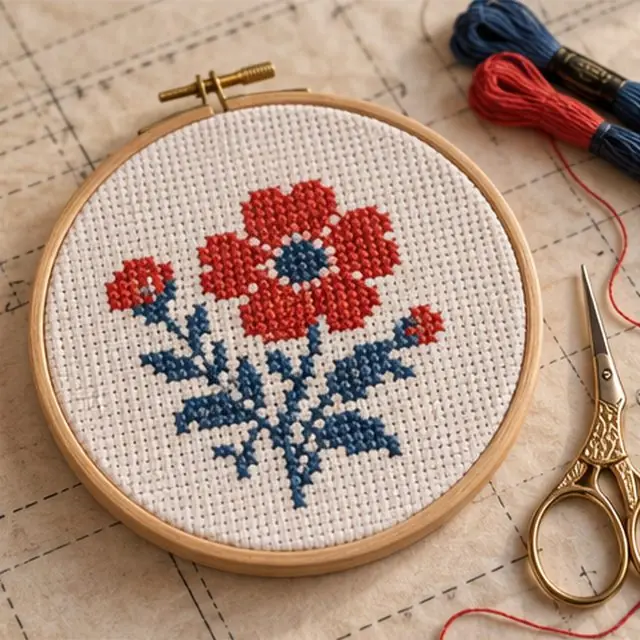
- The flower head is a mirror image both ways. Row 1 matches row 9, row 2 matches row 8 and row 3 matches row 7, and every row is centred on column 6, so comparing opposite petals is the quickest way to find a miscount.
- Neighbouring petals touch only at a corner. The pink can pass from one to the next through that shared hole, so it never has to run behind bare fabric, which Working with Multiple Colours warns against.
Common mistakes and fixes
The petals have merged into one round shape
The notch squares were filled. Rows 3 and 7 each need an empty square at column 4 and at column 8; take out any pink in those four places.
The stem is not under the middle of the flower
It was started from the edge of the bottom petal. The stem runs down column 6, the same column as the middle yellow cross, so count down from that cross to row 10 and restart there.
Check your result
- Your totals match the key under the chart: 9 yellow, 54 pink and 18 green.
- Four empty notches, one on each diagonal out from the yellow block, keep the petals apart.
- The top petal, the middle yellow cross and the whole stem line up in column 6.