 SewMendStitch
Start with the skein
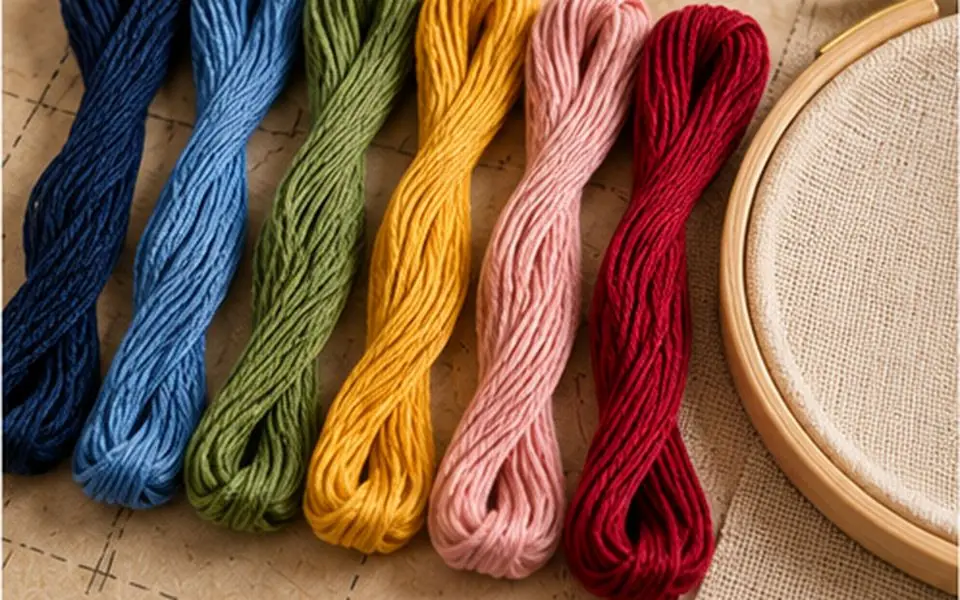
A standard skein of DMC six-strand cotton floss holds 8.7 yards, which is 8 metres.1 That is 313 in of thread, made of six fine strands twisted loosely together so you can pull out as many as you need.1 Nearly every floss estimate starts from those two numbers: the length of the skein and the number of strands you stitch with.
Charts from kit makers usually list how many skeins of each colour you need. Charts you buy as downloads, or designs you draw yourself, often do not. Running short halfway through means another trip to the shop and a skein that may not quite match. Buying ten skeins of a colour you use for 40 stitches wastes money. The sums below take a few minutes per colour.
How strands change the length you have
Because you separate the strands, one skein gives you far more stitching thread than 8.7 yd suggests. Six strands of 313 in each is 1,879 in of single strand. How you split it depends on the project.
- Stitching with 1 strand: about 1,879 in available.
- With 2 strands: 939 in (each 18 in cut gives you three 2-strand lengths).
- With 3 strands: 626 in.
- With all 6 strands: 313 in.
Not all of that goes into stitches. Each piece of thread loses a short tail when you start, another when you finish, and a bit more at the needle eye. Yarn Tree recommends cutting lengths of about 18 in.5 If you lose about 4 in per 18 in length, which is a reasonable working assumption rather than a manufacturer figure, then roughly 78 percent of the thread ends up in the fabric.
How much thread one cross uses
The figure here comes from geometry, not from a manufacturer, so the assumptions are spelled out. On 14-count fabric, each square is 1/14 in (0.071 in) on a side. A full cross has two diagonal arms on the front, each about 0.101 in long (the diagonal of the square). When you work in rows, the thread on the back travels straight up or down one square for each arm, so another 0.143 in. That makes about 0.345 in per cross. Thread does not lie perfectly flat; it passes through the fabric thickness and has some slack, so add 20 percent. The result is about 0.41 in of thread per cross on 14-count.
Scale that by the square size for other counts, and combine it with the usable length from the strands you use. The table below is the result. Treat it as a planning figure that can be off by a quarter either way, depending on your tension, how often you start new threads and how scattered the colour is.
| Fabric and strands | Thread per cross (est.) | Usable thread per skein (est.) | Crosses per skein (est.) |
|---|---|---|---|
| 11-count, 3 strands | 0.53 in | 487 in | about 900 |
| 14-count, 2 strands | 0.41 in | 731 in | about 1,750 |
| 16-count, 2 strands | 0.36 in | 731 in | about 2,000 |
| 18-count, 2 strands | 0.32 in | 731 in | about 2,250 |
| 18-count, 1 strand | 0.32 in | 1,462 in | about 4,500 |
| 28-count over two, 2 strands | 0.41 in | 731 in | about 1,750 |
Strand choices follow common starting points: 3 to 4 strands on 11-count, 2 on 14 and 16-count, 1 to 2 on 18-count.6 Using a third strand on 14-count drops the yield to about 1,175 crosses a skein, since each pass uses half again as much thread.
Worked example: 2,400 crosses of one colour
Suppose a chart has 2,400 full crosses in one shade of blue, stitched on 14-count Aida with 2 strands. Here is the estimate step by step.
- Skein length: 8 m = 8.7 yd = 313 in of six-strand floss.1
- Split into 2-strand lengths: 6 / 2 = 3 lengths from every piece, so 313 x 3 = 939 in of 2-strand thread per skein.
- Thread per cross: about 0.41 in (the geometric estimate above, including 20 percent for slack and fabric thickness).
- Thread in the fabric: 2,400 x 0.41 = 984 in.
- Allow for waste: if 14 in of every 18 in length ends up stitched, divide by 14/18 (0.78). 984 / 0.78 = 1,265 in of 2-strand thread to cut.
- Skeins: 1,265 / 939 = 1.35 skeins.
Round up to 2 skeins. If those 2,400 stitches are a solid block of sky, 2 skeins will leave a comfortable spare. If they are scattered through the design in small patches (stitchers call this confetti), each patch costs extra tails and longer runs on the back, so buy 3. If you plan to work a matching backstitch outline in the same colour with 1 strand, add its length too: measure the outline in inches, double it to allow for the back, and add it to the total.
The same arithmetic in reverse is useful for checking a kit. One skein at 14-count with 2 strands covers about 1,750 crosses. Divide the colour's stitch count by 1,750 and round up.
Counting stitches on a chart
Most charting software prints a key with a stitch count beside each colour. Use it. If the chart has no counts, count the symbols in one 10 by 10 block of the grid to get a feel for density, then estimate by blocks: a block that is entirely one symbol holds 100 stitches. For half stitches (one diagonal arm) count each as half a cross. Quarter and three-quarter stitches are close enough to count as a half and a full cross respectively for estimating; the fractional stitches lesson explains what they are.
Write the estimated skein count next to each colour on the key before you shop, and plan the order you will stitch them in (the multiple colours lesson helps). On a typical design this takes about ten minutes.
Estimating for surface embroidery fills
Free embroidery does not follow a grid, so you estimate by area. Satin stitch, long rows of straight stitches laid side by side to cover a shape (see satin stitch), uses the most thread because it travels across the back as well as the front. Seed stitch and other scattered fillings use far less.
A rough satin-stitch estimate, with the assumption stated: if a pass of 2 strands covers about 1/40 in (0.6 mm) of width, filling a 1 by 1 in square takes 40 passes of 1 in on the front and about the same on the back, so 80 in in the fabric. Allowing the same 78 percent efficiency, you cut about 103 in, which is roughly one-ninth of a skein's 2-strand thread. One skein then fills about 9 sq in (58 sq cm) of satin stitch.
Your own stitching will differ, so test it. Cut one 18 in length, stitch a 1/2 in square of the fill you plan to use, and note how much is left. Multiply what you used by four for a square inch, then by the area of your shape. The floss lesson shows how to separate strands cleanly for this kind of test.
Buying extra and dye lots
Factory-dyed floss from the large makers is dyed to fixed formulas, and DMC states that its dyes are colourfast so finished work can be washed without fading or bleeding.2 Even so, skeins bought years apart can look slightly different side by side, especially in pale colours and large areas. Hand-dyed floss varies more: Weeks Dye Works notes that hand dyeing can produce slight colour variations.3
Practical rules that follow from this:
- Buy every skein of a large-area colour at the same time, from the same shop.
- Round each colour up, never down, and add one spare skein for any colour that covers a big background.
- For hand-dyed or variegated threads, buy the full amount at once and alternate lengths from different skeins so any difference blends in.
- Keep the paper band from each skein until the project is finished, so you can match the number.
Storing floss
Light fades dyed fibres, and the damage builds up and cannot be undone. Guidance from the International Quilt Study Center and Museum at the University of Nebraska-Lincoln, written for textiles in the home, recommends keeping them in the dark, at 62 to 72 F (17 to 22 C) and 45 to 55 percent relative humidity, and away from attics, basements and laundry rooms.4 The same guidance warns that plain cardboard and wood give off acids that yellow fabric, and suggests new uncoloured HDPE or polypropylene containers lined with acid-free tissue or washed cotton.4
For floss, that translates into a closed plastic box with bobbins or zip bags labelled by colour number, kept in a cupboard rather than on a sunny shelf. Wind floss onto plastic bobbins if you can; cardboard ones are fine for a single project but not for years of storage. Store only clean, dry thread, since damp encourages mildew.4 Keep a written list of the numbers you own so you do not buy a fourth skein of black. Finished pieces need the same care; see caring for embroidery.
Common mistakes
- Assuming one skein per colour. A large background on 14-count can need five or more.
- Forgetting backstitch, French knots and outlines when totting up thread.
- Estimating with 2 strands and then stitching with 3. Recalculate if you change strands; usage rises by half.
- Cutting very long lengths to save starts. Lengths much over 18 in tend to fray and twist, so you lose more than you save.
- Ignoring confetti stitching. Scattered colours use noticeably more thread per stitch than solid blocks.
- Buying a top-up skein months later for a large area and hoping it matches.
If you run out anyway, finish whole areas or motifs in the new skein rather than switching in the middle of a block, so any small shade change falls along a natural edge.
Sources
- Mouliné Spécial six-strand embroidery floss, DMC
- DMC Mouliné 117, DMC
- Frequently Asked Questions, Weeks Dye Works
- To Protect & Preserve: Caring for Family Quilts in the Home, International Quilt Study Center & Museum, University of Nebraska-Lincoln
- Learn to Cross Stitch, Yarn Tree
- How Many Strands of Embroidery Floss Should I Use?, Colonial Needle Company
Links were checked when this guide was last reviewed. If one has moved, please let us know. How sources are chosen: editorial policy.