 SewMendStitch
Why the label is the first thing to read
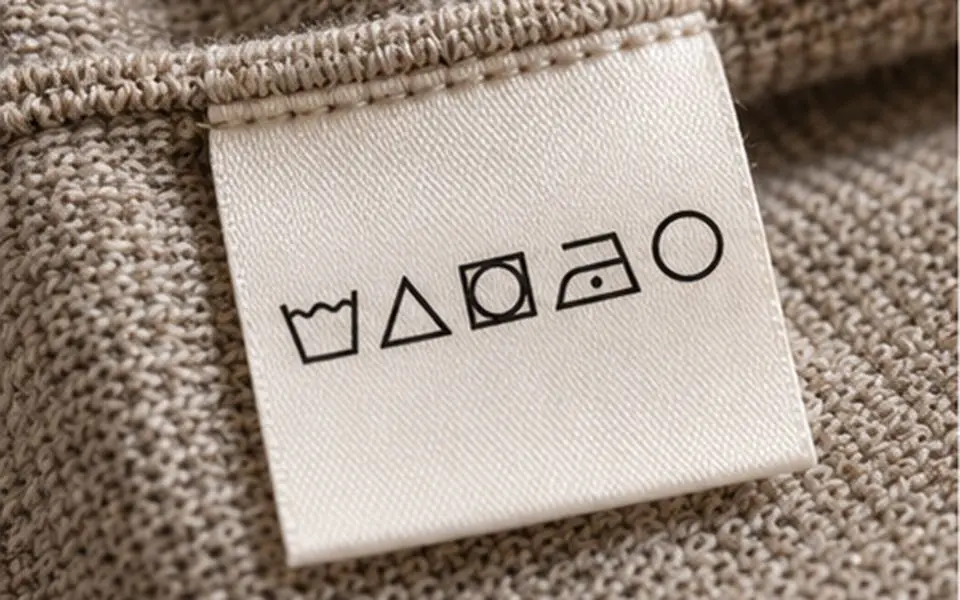
Turn almost any shirt inside out and you will find a small tag near the side seam or the back neck with a row of tiny pictures. In the United States that tag is required by law. The Federal Trade Commission's Care Labeling Rule says garments made of textile must carry care directions covering washing, bleaching, drying and ironing, plus a warning about any method a person might reasonably try that would damage the item.1 Shoes, gloves, hats, belts, neckties and handkerchiefs are exempt.1
For anyone who sews or mends, the label is more than laundry advice. It sets the iron heat for pressing a new hem, and it tells you whether a patch can be washed into place and which thread or interfacing will survive the garment's normal cleaning. Thirty seconds spent reading it prevents most scorched or shrunken repairs, the ones beginners tend to blame on their own hands.
The five symbol families
Both the American and the international systems are built on the same five basic shapes, and international labels list them in a fixed order: washing, bleaching, drying, ironing, then professional care.23
- Wash tub (a bucket shape with a wavy top line): how to wash in water. A hand dipped in the tub means hand wash only. A cross through the tub means do not wash at home.
- Triangle: bleach. An empty triangle allows any bleach when needed. A triangle with two slanted lines inside allows only non-chlorine (oxygen) bleach. A crossed-out triangle means no bleach of any kind.34
- Square: drying. A circle inside the square means tumble dry in a machine. Lines inside a square with no circle mean natural drying, such as hanging on a line or laying flat. A slanted line in the corner means dry in the shade.3
- Hand iron: ironing and pressing, with dots for the heat limit.
- Circle: professional care by a dry cleaner or a professional wet cleaner. Letters inside the circle are instructions for the cleaner about which solvents or process to use.3
A cross (an X) through any symbol means do not do that process. A crossed-out iron, for example, warns that an iron will cause damage that cannot be undone.3
Dots for temperature, bars for gentleness
Dots are the heat code wherever they appear on a label: more dots, more heat. On American (ASTM) wash symbols, one dot is about 30 C (85 F) and each extra dot steps up, to six dots at 95 C (200 F).5 International labels often print the number of degrees Celsius inside the tub instead of dots, using values such as 30, 40, 60 and 95.3
| Wash dots (ASTM) | Water temperature | Plain name |
|---|---|---|
| 1 dot | 30 C / 85 F | Cold or cool |
| 2 dots | 40 C / 105 F | Warm |
| 3 dots | 50 C / 120 F | Hot |
| 4 dots | 60 C / 140 F | Very hot |
| 5 dots | 70 C / 160 F | Extremely hot |
| 6 dots | 95 C / 200 F | Near boiling |
Bars under the tub set how rough the machine can be. No bar means a normal cycle. One bar means a milder cycle with less agitation, used for easy-care synthetics. Two bars mean a very mild cycle, the kind used for wool.3
For tumble drying, GINETEX (the international care-labelling association) lists a normal tumble dry at up to 80 C and a mild one at up to 60 C.3 The former Canadian guide gave slightly lower limits: 75 C for high heat, 65 C for medium and 55 C for low.4 On either scale, one dot in the dryer circle is the low setting.
The iron dots, with real temperatures
The iron symbol matters most to someone who sews, because pressing is part of every seam and hem. The American guide and the international system use the same one-to-three dot scale, but the published maximums are not identical. GINETEX, which follows ISO 3758, now gives slightly higher sole plate limits than the older ASTM figures.35
| Iron symbol | ASTM maximum | GINETEX maximum | Typical fibers |
|---|---|---|---|
| 1 dot | 110 C / 230 F | 120 C / 248 F | Nylon, acrylic, acetate, spandex |
| 2 dots | 150 C / 300 F | 160 C / 320 F | Wool, silk, polyester, rayon (viscose) |
| 3 dots | 200 C / 390 F | 210 C / 410 F | Cotton, linen |
| Iron crossed out | Do not iron | Do not iron | Some sequined, plastic-coated or embossed items |
The fiber column comes from the Canadian guide and from GINETEX.34 GINETEX adds a practical point: when a garment has a care label, set the heat by the dots, not by what you think the fiber is, because finishes, prints and trims can lower the safe limit.3 There is also a do-not-steam version of the iron symbol, which means press dry.4
Household irons are rarely marked in degrees. Most dials carry the same dots as the label, so you can match one to the other without converting.
US rules versus the international system
The two systems look almost the same, but they differ in a few places. Under the FTC rule, a label may use symbols instead of words only if those symbols come from the ASTM D5489-96c version of the guide; ISO symbols are not accepted on a symbols-only label under the current rule text.1 ASTM has revised the guide since then, and the current edition is D5489-25. Its page notes that the newer D5489-18 symbols can appear on US labels only when full English instructions sit beside them.2
In Europe and much of the rest of the world, labels follow ISO 3758, which GINETEX promotes. The fourth edition, ISO 3758:2023, replaced the 2012 version.3 The practical differences for a home sewer are small: international labels tend to print the wash temperature as a number, use letters in the professional care circle, and quote the slightly higher iron limits shown above.
The US rule has two more requirements. A label that says "Dryclean only" must be backed by evidence that washing would harm the garment.1 If neither washing nor dry cleaning is safe, the label has to say so in words: do not wash, do not dryclean.1
Worked example: wool trousers you plan to hem
Say you have a pair of 100% wool trousers with a 31 in (79 cm) inseam and you want a 29 1/2 in (75 cm) finished length. The current hem allowance (the fabric folded up inside) is 2 in (5 cm). The label shows, from left to right: a crossed-out tub, a crossed-out triangle, a crossed-out square with a circle, an iron with two dots, and a circle with a letter inside. The words underneath say "Dry clean only".
Take the symbols in order. Crossed-out tub: never wash these at home, including the hem area. Crossed-out triangle: no bleach. Crossed-out tumble dryer: never put them in a dryer. Two-dot iron: the sole plate must stay at or below 150 C (300 F) by the ASTM figure, or 160 C (320 F) by the GINETEX figure.35 The circle with a letter: the dry cleaner will choose the solvent, and you do not need to decode the letter.3
Those symbols decide how you hem. You are shortening by 1 1/2 in (3.8 cm), so you will unpick the old hem, mark the new fold 1 1/2 in higher with tailor's chalk, and trim so you keep a 1 1/2 in (3.8 cm) allowance, cutting off 2 in (5 cm) in total. Use chalk rather than a water-soluble pen, because these trousers will never be rinsed to remove the ink.
Set your iron to the wool setting (two dots) and press the new fold with steam through a press cloth, a plain piece of cotton laid between iron and fabric. Wool pressed directly with the iron develops a shine that does not come out.6 Test first on the 2 in strip you cut off. If you want to add hem tape, choose one that will survive dry cleaning; polyester tape is a safe choice. Finish the hem by hand with a blind hem stitch so nothing shows on the outside, following the steps in hemming trousers.
Garments with no label, and why labels matter before mending
Labels go missing. Many are cut out because they itch, and handmade clothes often never had one. The FTC rule also exempts some items entirely, including garments custom-made from material the customer supplied.1 Fabric remnants up to 10 yards can be sold without care information when the fiber content is unknown, as long as they are marked "fabric of undetermined origin" or "pound goods".1
With no label, treat the item as the most delicate thing it could be. Hand wash it in cool water and dry it flat. Press at one dot first, and raise the heat a step only after a test on an inside seam allowance shows no shine or puckering and nothing melts. A burn test on a few threads pulled from inside a seam allowance can also narrow down the fiber; the separate guide to fabric fibers walks through it.
Patch fabric has labels too. Fabric sold off the bolt in the US must carry care information on the end of the bolt or roll.1 Photograph that end label when you buy. If it allows washing, wash and dry the patch fabric the same way the garment is washed before you cut it. A patch that shrinks after it is sewn on pulls the surrounding fabric into ripples; a 4 in (10 cm) cotton patch that shrinks 3 percent loses about 1/8 in (3 mm), which is enough to pucker the edges. See sewing a patch by hand for the method.
Common mistakes
- Setting the iron by fiber name alone when the label shows fewer dots. A polyester print or a glued trim can need one dot even if the base fabric would take two.
- Reading one bar under the tub as "warm". Bars describe agitation, not heat; dots or numbers give the temperature.
- Pre-washing a patch for a dry-clean-only garment. The garment will never be washed, so washing the patch adds nothing and may change its color or texture so it no longer matches.
- Using a water-soluble marking pen on a garment that cannot be washed.
- Ignoring a crossed-out steam symbol. Steam can leave water spots on some silks and rayons, or flatten a raised surface.
- Cutting the label out completely. If it itches, unpick it and sew it flat inside a pocket or at a seam allowance so the information stays with the garment.
Before any repair, check that what you add, such as fusible interfacing or hem tape, will survive the garment's cleaning and its iron setting. Fusible products print their own heat needs on the packaging, and one that needs a three-dot iron will not bond to a garment labelled one dot. The lesson on matching thread covers choosing thread color and weight.
Sources
- Clothes Captioning: Complying with the Care Labeling Rule, Federal Trade Commission
- ASTM D5489: Standard Guide for Care Symbols for Care Instructions on Textile Products, ASTM International
- Care symbols, GINETEX
- Guide to Apparel and Textile Care Symbols, Office of Consumer Affairs, Innovation, Science and Economic Development Canada
- Guide to Apparel/Textile Care Label Symbols, Eurofins
- Pressing Pointers (Guide C-309), New Mexico State University Cooperative Extension Service
Links were checked when this guide was last reviewed. If one has moved, please let us know. How sources are chosen: editorial policy.