 SewMendStitch
What happens to a raw edge
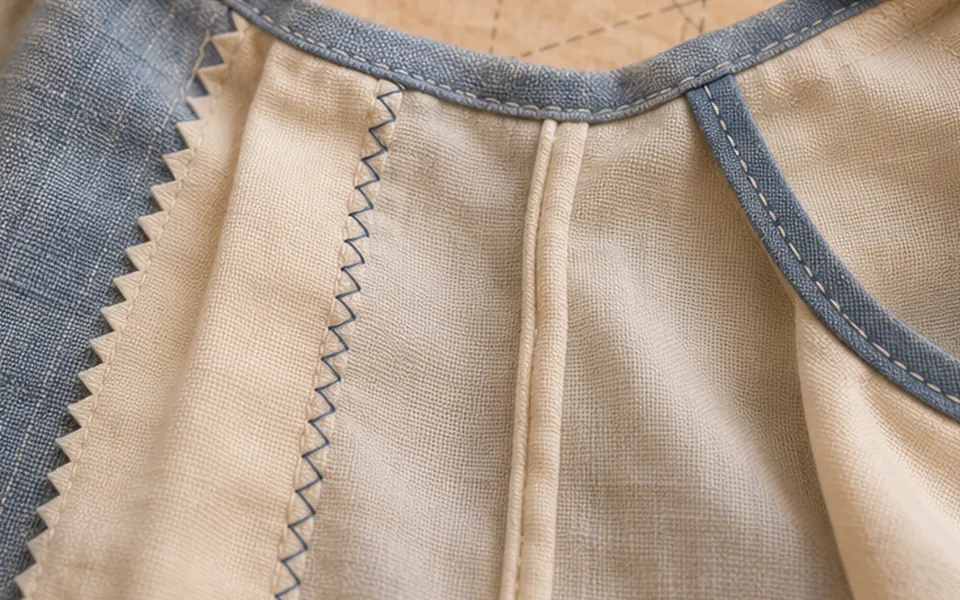
Cut a strip of loosely woven linen, rub the cut edge between finger and thumb a dozen times, and loose threads will already be falling out. Leave a 5/8 in (15 mm) seam allowance in that cloth unfinished and it will shed threads from the first wash. Once fraying reaches the stitching, the seam opens.
This happens because a woven fabric is two sets of threads lying over and under each other. At a cut edge, nothing holds the last few crosswise threads in place, so friction and washing work them loose. Woven fabrics ravel; knits generally do not, because their loops interlock, but knit edges tend to curl or roll instead.1 A seam finish is any treatment of the raw edge of a seam allowance that stops it fraying, curling or rolling.1 The more a fabric frays, the closer together the stitches of a zigzag or hand overcast finish need to be.1
If you have never sewn a finish before, start with finishing seam allowances, which walks through a basic zigzag and a turned edge.
The finishes side by side
The times are rough figures for a beginner finishing about 1 yd (90 cm) of seam, both allowances, on a basic machine. Bulk means the ridge a finish adds once pressed. Strength here is about how well the edge resists fraying and wear, not the strength of the seam line itself; the exception is the enclosed seams, which are seam and finish in one.
| Finish | Suits | Rough time | Bulk | Strength |
|---|---|---|---|---|
| Stitched and pinked | Firmly woven fabric, items that get little wear1 | 5 min | Very low | Weak: limits fraying but does not stop it1 |
| Zigzag | Medium to heavy wovens, including corduroy1 | 8 min | Low | Good |
| Three-step zigzag | Medium, heavy and stretch fabrics3 | 10 min | Low, lies flatter than plain zigzag | Good |
| Turned and stitched (clean finish) | Lightweight wovens; not heavy fabric or knits1 | 15 min | Medium | Good |
| French seam | Lightweight, sheer and delicate wovens12 | 20 min | Low on fine cloth, too bulky on thick | Strong, edges fully enclosed1 |
| Flat-felled | Wovens with straight seams: shirts, jeans, pajamas, workwear12 | 25 min | Medium, flat on both sides | Strong, built for hard wear2 |
| Hong Kong (bound) | Woven jackets and coats with exposed seams12 | 40 min | Medium to high | Very good, neat inside |
| Overlocked (serged) | Wovens; knits only if the edge curls1 | 5 min | Low | Good; depends on thread count4 |
| Hand overcast | Woven fabric, including curves and L or V shapes1 | 30 min | Very low | Fair to good |
Edge finishes: each allowance treated on its own
Five of the nine finishes wrap or trim the raw edge and leave the seam itself unchanged, so they work on seams pressed open or pressed to one side.
Pinking means trimming with zigzag-bladed shears. Kentucky Extension pairs it with a line of straight stitching 1/4 in (6 mm) from the edge and warns that pinking alone is not reliable.1 Ohio State Extension calls stitched and pinked an uncommon finish for the same reason: the cloth can still ravel back to the stitching.2 Keep it for firm cotton that will be lined or rarely washed.
A plain zigzag is sewn about 1/8 in (3 mm) from the raw edge and trimmed close.1 One Brother operation manual lists its standard zigzag at 3.5 mm wide and 1.4 mm long for overcasting, and its three-step elastic zigzag at 5.0 mm wide and 1.0 mm long for medium, heavyweight and stretch fabrics.3 The three-step version puts three short stitches into each swing, so the edge is caught more often and the fabric is less likely to tunnel (draw up into a ridge under the stitch). For machine settings and practice, see uses for the zigzag stitch and finishing raw edges by machine.
The turned and stitched finish, also called a clean finish, folds the raw edge under and stitches about 1/4 in from it.1 On a light shirting it looks tidy and wears well. On denim or wool coating the double layer leaves a ridge that shows through when pressed.
Hand overcasting wraps the edge with slanted stitches, starting about 1/4 in from the edge and spacing them roughly 3/8 in (10 mm) apart, closer on cloth that frays badly.1 It is slow but adapts to awkward repair spots better than any other finish. Learn it in the overcast stitch.
Enclosed and bound finishes
A French seam is sewn twice. The first row goes wrong sides together about 3/8 in (10 mm) from the edge, the allowance is trimmed to 1/8 to 1/4 in (3 to 6 mm), and the seam is folded right sides together and stitched again about 1/4 in from the fold, trapping the raw edges inside.1 It is the neatest finish there is on voile or silk, but on anything thicker than a medium shirting the folded layers get stiff.
For a flat-felled seam, you trim one allowance, fold the other over it and stitch it flat, which leaves two parallel rows of stitching on the outside. Kentucky Extension trims the under allowance to 1/8 in and turns the top one under 1/4 in.1 According to Ohio State, the finished fell should be no wider than 5/16 in (8 mm) between rows.2 You will see it on jeans and shirts,2 and it is meant for straight edges.1
The Hong Kong finish binds each allowance separately in a bias strip of lightweight woven fabric, 1 1/4 to 1 1/2 in (32 to 38 mm) wide, stitched 1/4 in from the edge.1 It is the slowest finish in the table, so save it for an unlined jacket where the inside shows.
Overlocked seams and what the thread count tells you
An overlock machine (serger) trims, stitches and wraps the edge in one pass.4 What it can handle depends on how many threads it uses. A three-thread overlock is most useful on knits and can be used on wovens, but New Mexico State University advises keeping it out of stress points such as a trouser crotch or shirt sleeve seams.4 NMSU describes two four-thread models. The safety stitch model runs two needles and two loopers and can seam wovens or knits, stress points included.4 The chain stitch model is most useful on wovens; its chain does not stretch, so keep it out of knit seams.4 A 4-H guide from Purdue Extension describes the five-thread safety stitch as a stable, durable seam used mostly on woven fabric.5 Without a serger, a three-step zigzag is the closest home substitute on most fabrics.
Mending ready-to-wear: copy what the factory did
When a seam on a bought garment splits, turn it inside out and identify the finish before you thread a needle. Then rebuild what was there, since the factory chose that finish for the fabric and for the wear the garment gets.
- Wrapped edge with three or four threads and one or two needle lines: overlocked. Count the needle lines. Two straight lines inside the wrap usually mean a four-thread overlock (the two-needle safety stitch model). A separate chain stitch running beside the wrapped edge means a chain-stitch seam of four or five threads, firm on wovens but with little stretch.
- Two rows of stitching on the outside and no raw edge inside: flat-felled. You will need to refold the fell and topstitch both rows.
- A narrow rolled ridge on the inside of a fine blouse: French seam.
- Raw edges with zigzag-cut teeth: pinked, usually inside a lined garment.
You cannot always copy a factory finish exactly at home. Match the class of finish instead: enclosed for enclosed, wrapped for wrapped. Restitch the seam line first, following fixing a split seam, then rebuild the edge. On knits, where a stretched serged seam has burst, see repairing a popped seam instead, because the new stitch must stretch.
Worked example: a linen shirt and a fleece jacket
Two garments arrive with 4 in (10 cm) splits in the side seam.
The linen shirt has French seams. When you open the split, the trapped edges are fraying inside the fold, and loose linen threads are hanging out. Unpick 1/2 in (12 mm) of sound stitching past each end of the split. Trim the frayed threads level with the old trimmed edge, which should leave about 1/8 in. Restitch the inner seam along its old line, then refold and sew the outer line 1/4 in from the fold, overlapping the old stitching by 1/2 in at each end.1 If the edge has frayed too far to fold, switch the repaired section to a turned and stitched edge or a close three-step zigzag (Brother's default 5.0 mm wide, 1.0 mm long) on both allowances together.3 Time: about 25 minutes.
The fleece jacket is polyester, with a four-thread overlocked seam. Fleece does not fray, so a finish is optional on this fabric.6 The repair does need to stretch a little as you move. Sew the seam with a slightly long straight stitch, around 3 to 4 mm, as Simplicity suggests for fleece, using a 90/14 ballpoint needle.6 Add a row of zigzag through both allowances if you want the inside to look like the factory finish. Do not turn the edges under; on a thick pile that would add two extra layers of bulk for no benefit. Time: about 10 minutes.
Common mistakes
- Pinking a loose weave such as linen or gauze and expecting it to survive the wash.
- Sewing a wide zigzag right on the edge of light fabric. It tunnels and puckers; Ohio State notes light fabric can pucker under an overcast edge.2 Narrow the stitch or sew it slightly in from the edge and trim.
- Using a French seam on a tight curve. Kentucky Extension suggests a mock French seam where curves make the real one hard to handle,1 and a narrow zigzag or overlocked finish also works.
- Finishing the seam allowance after a crossing seam has been sewn over it. Finish first, then join.
- Turning under the edges of fleece, felt or heavy knit, which never needed a finish at all.
- Repairing a three-thread overlocked crotch seam with the same three-thread stitch. That stitch is not advised for stress points,4 so back the repair with a straight seam just inside the overlock.
If you are unsure which finish to use on a new fabric, sew 6 in (15 cm) of three different finishes on a scrap, wash it once, and keep the one with the fewest loose threads.
Sources
- Seams and Seam Finishes (FCS2-304), University of Kentucky Cooperative Extension
- Seam Finishes: Choosing the Correct Seam Finish, Ohio State University Extension, Franklin County
- Utility Stitches (sewing machine operation manual), Brother
- Selecting an Overlock Sewing Machine (Guide C-218), New Mexico State University Cooperative Extension Service
- Sewing With Sergers, Purdue University Extension, Elkhart County 4-H
- Tips for Sewing with Fleece Fabrics, Simplicity
Links were checked when this guide was last reviewed. If one has moved, please let us know. How sources are chosen: editorial policy.