 SewMendStitch
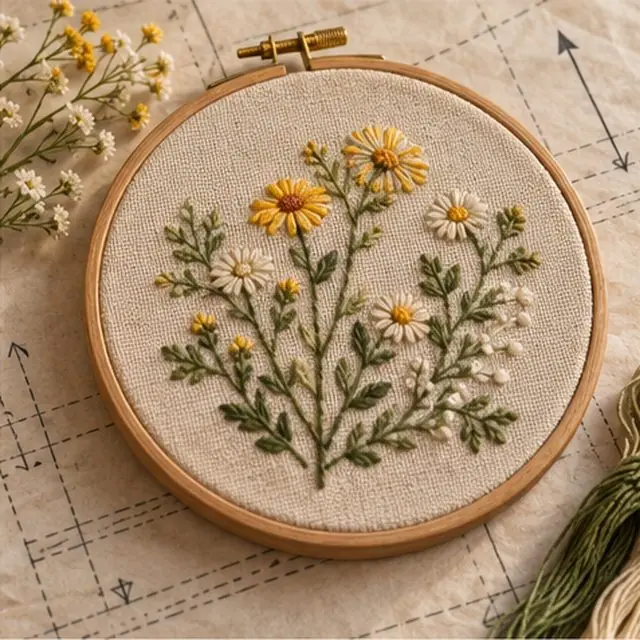
What you will learn
- Single detached loops
- Arranging petals evenly
Materials and tools
Before you start
- Thread 3 strands for all three practice daisies, so the only things that change are the number and length of the petals.
- Mark three centres 1.25 in (3 cm) apart. Round the first, draw five petal lines 3/8 in (1 cm) long; round the second, eight of them; round the third, five lines 5/8 in (15 mm) long for narrow petals.
- Turn the hoop so the petal you are working points away from you. Each loop is then made with the same hand movement.
Step by step
Placing the petals
Petals come out even when their positions are fixed before you stitch. A clock face helps: six petals sit at 12, 2, 4, 6, 8 and 10, and eight sit at the four quarter hours with one more between each pair. Start each petal a little out from the centre dot, about 1/16 in (2 mm), so the bases form a tiny ring instead of crowding into one hole. The ring leaves room for a French knot and stops the middle turning into a cluster of needle holes.
Variations on one loop
Stretch the tiny stitch at the tip into a long straight stitch and the petal becomes a bud on a stalk, or a leaf with its own stem. A second, smaller loop worked inside the first in another shade gives the petal a coloured heart; this is often called a double lazy daisy. For a simple tulip, make three loops from one base point, the middle one upright and the other two leaning out.
Worked example: a sprig of lavender
Start with a straight stem 2 in (5 cm) long, worked in stem stitch with 2 strands of green. Along the top 1 in (2.5 cm), mark five pairs of short lines angled upward like a row of Vs, each line 3/16 in (5 mm) long and the pairs 3/16 in (5 mm) apart, plus one upright line at the tip: eleven in all. Work each line as a lazy daisy in 2 strands of purple, starting every loop at the stem so the buds point up and out. At this size, 3 strands would make the buds look swollen.
Questions beginners ask
Which end of the loop goes at the centre? The end where the needle goes down and comes up in the same hole is the narrow end, so it belongs at the flower centre or against the stem. The rounded end opens outward.
Will lazy daisies survive on clothes? Each one is a loop held at a single point, so it can catch. On anything worn, keep petals no longer than 3/8 in (1 cm) and pull each tip stitch firm.
- Leave the loop a little loose for a round petal. Pull tighter for a narrow leaf.
- Fill the centre with a French knot or two.
Common mistakes and fixes
Petals are different sizes
Mark all the petal lines first and bring the needle up exactly at each tip.
The petal collapses into a line
The loop was pulled too tight before anchoring.
Check your result
- Petals are open, similar in size and evenly spaced.
- Each tip has a small anchoring stitch.