 SewMendStitch
What elastic is and what it has to do
Most pajama pants that slide down by bedtime have sound fabric and a worn-out strip of elastic inside the waist. Elastic is a narrow band built around stretchy core strands of rubber or spandex, with ordinary yarns worked around them by braiding, knitting or weaving.
Two properties decide whether it works: how far it extends under a pull (its stretch) and how completely it comes back to its starting length afterwards (its recovery). Spandex (also called elastane) can be stretched more than 500 percent without breaking and returns very nearly to its original length; the fiber makers' trade association also calls it stronger and more durable than rubber, with more pulling-back force.5
Elastic goes into clothing in one of two ways: it runs loose inside a casing (a fabric tunnel along a waist or cuff), or it is stitched straight onto the fabric. Not every elastic survives the second method, so decide which one your project uses before you buy.
Braided, knitted and woven elastic
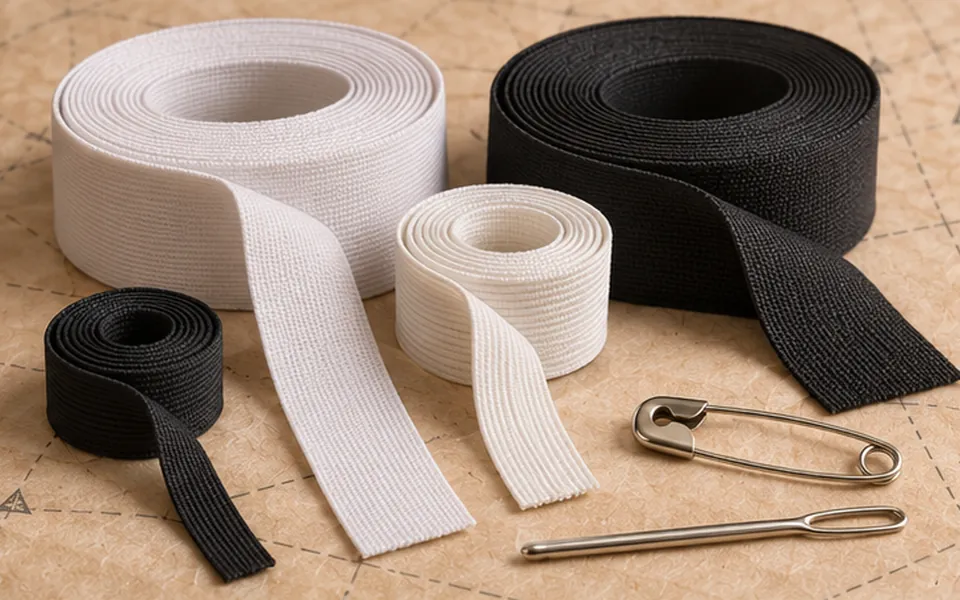
Look at the surface of the band to tell these apart.
- Braided elastic has lengthwise ridges, like a tiny flat plait. Because it narrows noticeably when stretched, Threads magazine recommends keeping it in a casing instead of sewing through it.2 This lightweight type turns up in sleeves, swimwear and leg bands.3 Stitch through it anyway and the band narrows and twists between the stitches.
- Knitted elastic is soft and flat, with a fine, even surface. Unlike braided, it keeps its width when stretched and can usually be sewn directly to the fabric.2 The Threads elastics chart calls it durable and curl resistant.3
- Woven elastic is firmer, with crosswise ribs you can see and feel, and it too holds its width under tension.2 The non-roll kind is made to resist rolling and twisting; Dritz sells it for waistbands, sleeves and leg bands in light to medium-weight fabrics.4 For waistbands on heavier cloth there is a ribbed non-roll version.3
When you sew through any elastic, Threads advises a ballpoint, universal or stretch needle, so the point slips between the rubber strands instead of piercing them; it also suggests sewing with a straight, zigzag or knit stitch while the elastic is stretched.2 The zigzag stitch lesson covers the setting most beginners use.
Clear, fold-over and buttonhole elastic
Clear elastic is a thin transparent strip with no yarn structure at all. It stretches to three or four times its length and is used in swimwear and activewear, and to stabilize seams in knit fabrics so they do not grow.3 The common widths are 1/4 in (6 mm) and 3/8 in (10 mm), and it resists oil, chlorine and dry cleaning.1 You stitch straight through it: sew the seam, lay the elastic over the seam allowances, stitch again about 1/4 in away, then trim.3
Fold-over elastic has a line or groove down its center. Fold it along that line over a raw edge and it wraps the edge like binding, finishing and gathering in a single pass. Soft and lightweight, it is used most on knit garments and lingerie.3
For an adjustable waist there is buttonhole elastic, woven with small slots at regular intervals. It runs through a casing with its ends left long, and those ends button onto buttons sewn inside the garment, so the waist can be let out or taken in one slot at a time.3 Its usual width is 3/4 in (19 mm), and Threads suggests cutting it a few holes longer than the body measurement, longer still for maternity wear.1
Widths and typical uses
Width changes how a waistband feels as much as type does. A narrow strip concentrates the grip into a thin line that can dig in, while a wide one spreads the same pull over more skin. The table pairs common widths with the uses Threads lists for them.13
| Width | Common types | Typical uses |
|---|---|---|
| 1/8 to 1/4 in (3 to 6 mm) | Polyester braid | Gathered sleeves and cuffs, baby and doll clothes |
| 1/4 to 3/8 in (6 to 10 mm) | Clear, swimwear, picot lingerie | Knit seams, swimsuit edges, underwear |
| 1/2 in (13 mm) | Lightweight non-roll, lingerie | Sleeves, leg bands, light waistbands |
| 3/4 in (19 mm) | Non-roll, buttonhole | Skirt and children's waistbands, adjustable waists |
| 1 in (25 mm) | Non-roll, cut-through, gripper | Adult waist casings, cycling shorts hems |
| 1 1/4 to 1 1/2 in (32 to 38 mm) | Sport, drawcord, cut-through | Pajamas, boxers, athletic pants |
| 2 in (51 mm) | Action | Hard-wearing waistbands with several rows of topstitching |
In a casing, choose elastic that fills the tunnel with roughly 1/8 in (3 mm) to spare. Narrower elastic flips over inside; wider elastic will not pull through at all.
How long to cut elastic for a waistband
Elastic is cut shorter than the body so it holds the garment up. How much shorter depends on how hard the elastic pulls back, so no single ratio fits every type. Threads gives these starting points for waistbands, each measured from the body, not from the garment:1
| Elastic | Threads cutting rule | On a 30 in (76 cm) waist |
|---|---|---|
| No-roll (woven) | 1 in smaller than body | 29 in (97%) |
| Drawcord | About 2 in shorter | 28 in (93%) |
| Cut-through | 3 in smaller | 27 in (90%) |
| Sport (pajamas, boxers) | 3 to 5 in smaller | 25 to 27 in (83 to 90%) |
| Action, 2 in wide | Same as body | 30 in (100%) |
| Buttonhole | A few holes longer than body | Adjustable |
The percentages are plain arithmetic on a 30 in waist, and they show how far apart the rules sit: about 83 percent of the body measurement for soft sport elastic, against the full measurement for wide, firm action elastic.
Then add for the join: about 1 in (2.5 cm) of overlap where the ends are stitched together.1 A second Threads method skips the table: wrap the elastic comfortably around the waist, add 1 in in total, and trim before closing the casing if it proves too long.2 Use that for an unfamiliar elastic, since the wrap accounts for its pull.
Wrist and ankle casings go the other way. Threads suggests cutting no-roll elastic 1 to 2 in larger than the body measurement there, since a cuff only needs to rest in place.1
Testing stretch and recovery
Textile labs measure the tension and elongation of wide and narrow elastics on a tensile testing machine, following ASTM D4964.7 At home a ruler gives you enough information to pick between two elastics or to judge an old one.
- Mark 10 in (25 cm) on the relaxed elastic with chalk or two pins.
- Stretch it firmly, short of straining, and measure between the marks. If they reach 20 in, the elastic stretches to twice its length, a ratio of 2.
- Hold it stretched for 30 seconds, let go, and leave it for a minute.
- Measure again. Good elastic settles back to 10 in or within about 1/8 in (3 mm). Elastic that stays at 10 1/2 in or more has lost recovery and will keep sagging in wear.
Use the stretch ratio before you cut. The finished loop has to pass over the hips, or over the head for a neckline. If your loop length times the ratio comes out shorter than the hip measurement, the garment will not go on. Cut longer or choose a stretchier elastic.
Worn elastic usually shows itself: it crackles when pulled, keeps ripples after you release it, or has fine rubber threads poking from the edges. Replace elastic like that. If it still springs back well and the only problem is a loose waist, shortening the elastic is the quicker fix.
Why elastic wears out
Rubber and spandex fail for different reasons, and laundry habits speed up both.
Natural rubber reacts with oxygen in the air. According to the Canadian Conservation Institute, it can turn hard and cracked or soft and sticky as it oxidizes; ozone attacks it very quickly, light damages some rubbers, and higher temperatures speed deterioration.6 Rubber held under stretch also oxidizes faster,6 which is one reason a waistband worn stretched all day gives out before a loose cuff made from the same elastic.
Spandex stands up to body oils, sweat and detergents, but the fiber makers' association says chlorine bleach should not be used on any fabric containing it. The association's care advice is lukewarm washing and a low dryer setting, followed by a quick pass with a low iron.5 For pool wear, look for swimwear elastic sold as chlorine resistant.1
Dritz rates its non-roll woven elastic as machine washable and dryable at temperatures up to 200°F (93°C),4 but cooler washing still helps, since heat speeds aging.6
Worked example: pajama pants with a 30 in waist
These pajamas are cotton flannel, with a casing 1 3/8 in (35 mm) wide. Their old elastic, 1 1/4 in wide, crackles when stretched and stays wavy when released. Measured where the pants sit, the wearer's waist is 30 in (76 cm); the hips are 38 in (97 cm).
- Choose the elastic. A 1 1/4 in (32 mm) sport or knit elastic fills the casing with 1/8 in to spare, and Threads lists sport elastic at this width for pajamas.1
- Calculate the length. The sport rule is 3 to 5 in smaller than the body: 30 - 3 = 27 in and 30 - 5 = 25 in.1 For sleepwear, start at the looser end, 27 in, since a soft hold is more comfortable lying down.
- Add the overlap: 27 + 1 = 28 in (71 cm). Cut at 28 in.
- Check the hips. A 10 in test strip of the new elastic stretched to 19 in, a ratio of 1.9. The joined loop is 27 in, and 27 x 1.9 = 51 in, well past the 38 in hips. The loop only has to reach 38 / 27 = 1.4 times its length, so it slides on easily.
- Thread the elastic through the casing with a bodkin or safety pin, overlap the ends 1 in and pin them. Try the pants on, then sit and bend in them. If they slip, take up the overlap 1/2 in at a time, but not past the 25 in limit.
- Stitch the overlap in a box or zigzag as shown in replace basic elastic, then close the casing opening with a slip stitch. A few stitches through casing and elastic at each side seam stop it twisting later.
If the pants also had a drawstring, thread the new cord once the elastic is in; replace a drawstring explains how. For pants that never had a casing, build one with the elastic casing waistband lesson.
Common mistakes
- Cutting elastic to the garment's waist instead of the body's. The garment edge is gathered, and every Threads rule starts from a body measurement.1
- Sewing through braided elastic. It narrows as it stretches and belongs in a casing.2
- Using one percentage for every elastic. The rules run from the full body measurement for wide action elastic to 5 in less for soft sport elastic.1
- Buying elastic much narrower than the casing, which lets it roll and flip inside.
- Drying elastic garments on the hottest setting or washing them with chlorine bleach.56
- Sewing with old stash elastic without checking its recovery.
Where you can, buy elastic by the yard instead of in short packs. A 1 in non-roll waistband for a 30 in waist uses 29 + 1 = 30 in, so a full yard (36 in) leaves 6 in for a test strip before you cut the real piece.
Sources
- Elastic for Every Project, Threads Magazine (Taunton Press)
- A Guide to Indispensable Elastics for Garment Sewing, Threads Magazine (Taunton Press)
- Elastic types and applications (chart, PDF), Threads Magazine (Taunton Press)
- 1" Non-Roll Elastic, White, 12 yd, Dritz (Prym Consumer USA)
- Spandex Fiber, American Fiber Manufacturers Association (FiberSource)
- Care of Objects Made from Rubber and Plastic (CCI Notes 15/1), Canadian Conservation Institute, Government of Canada
- ASTM D4964-96(2016) Standard Test Method for Tension and Elongation of Elastic Fabrics (Constant-Rate-of-Extension Type Tensile Testing Machine), ASTM International
Links were checked when this guide was last reviewed. If one has moved, please let us know. How sources are chosen: editorial policy.