 SewMendStitch
What is folded up inside a hem
Unpick the hem of a pair of ready-made jeans and you usually find about 1 inch (25 mm) of fabric: a 1/2 inch (13 mm) fold turned up twice.4 A wool skirt may hide 2 or 3 inches (5 to 7.5 cm), a full circle skirt less than half an inch. That depth changes how the garment hangs, and it caps how much length you can ever get back by letting the hem down.
Four terms, used the same way throughout:
- Finished length: the garment's measurement once it is hemmed. For trousers this is usually the inseam, measured along the inner leg seam from the crotch seam to the bottom edge.
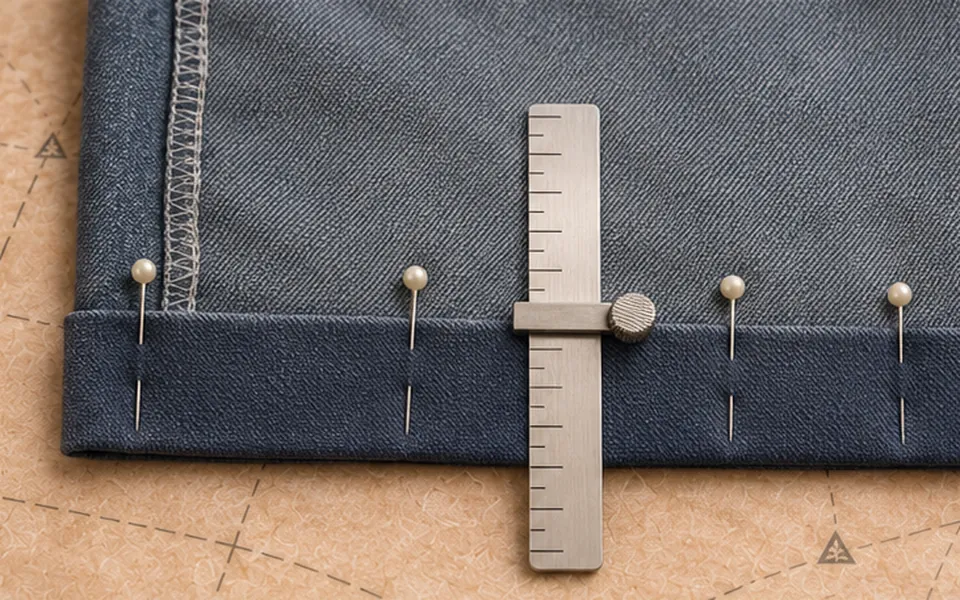
- Hem depth: the width of the turned-up band, from the fold to the top of the hem.
- Turn-under: a small extra fold, often 1/4 to 1/2 inch (6 to 13 mm), that tucks the raw edge out of sight. Some hems skip it because the edge is zigzagged, serged or bound instead.
- Hem allowance: all the fabric below the finished length. For a single fold with a turn-under it is depth plus turn-under. For a double fold where both folds are the same width, it is twice the depth.
McCall's and Simplicity patterns use a 5/8 inch (1.5 cm) seam allowance unless the instructions say otherwise.6 That figure says nothing about the hem. Find the hem allowance in the pattern's own instructions rather than assuming it matches the seams.
Typical hem depths, garment by garment
Three published charts mostly agree: New Mexico State University's extension guide to garment hems,1 the University of Kentucky's extension guide,2 and the American Sewing Guild's chart.3 The ASG notes that style and fabric weight both shift the right depth,3 so go deeper for heavy wool and narrower for light or sheer cloth.
| Garment | Typical finished depth | Source |
|---|---|---|
| Men's trousers | 2 in (5 cm) | ASG3 |
| Women's dress trousers | 5/8 to 1 1/4 in (1.5 to 3.2 cm) | ASG3 |
| Pants, general | 1 1/2 to 2 in (3.8 to 5 cm); NMSU gives 1 to 2 in | Kentucky2, NMSU1 |
| Jeans | About 1/2 in (13 mm), folded twice | Singer4 |
| Straight skirts and dresses | 2 1/4 to 3 in (5.7 to 7.5 cm); ASG gives 2 to 3 in | Kentucky2, ASG3 |
| A-line skirts and dresses | 1 1/2 to 2 in (3.8 to 5 cm) | Kentucky2 |
| Full, flared or circular skirts | 1/2 to 1 in (1.3 to 2.5 cm); ASG gives 1/4 to 3/8 in | Kentucky2, NMSU1, ASG3 |
| Dresses, sheer fabric | About 1/2 in (13 mm) | ASG3 |
| Shirts worn tucked in | 1/4 to 1/2 in (6 to 13 mm) | Kentucky2 |
| Blouses worn untucked | 3/8 to 3/4 in (1 to 2 cm) | ASG3 |
| Pullover tops | 1 to 1 1/2 in (2.5 to 3.8 cm); ASG gives 3/8 to 1 1/4 in | Kentucky2, ASG3 |
| Sleeves | 1 to 1 1/2 in (2.5 to 3.8 cm) | Kentucky2 |
| Jackets and coats | 1 1/2 to 2 in light, 2 to 3 in heavy | Kentucky2 |
| Curtains, bottom hem | 3 to 4 in (7.5 to 10 cm), turned up twice | BERNINA5 |
Most of the disagreement comes down to fabric weight. The ASG's 1/4 to 3/8 inch figure for flared skirts suits a machine-rolled edge on light cloth, while the extension guides' 1/2 to 1 inch suits medium-weight fabric.
Why flared hems have to be narrow
When you fold up a straight hem, the cut edge lies flat against the garment because both are the same width. On a flared skirt the hem edge is wider than the band of skirt it folds up against, and the mismatch grows with every extra inch of depth.
A full circle skirt makes the arithmetic easy, because every ring of a circle measures 2 x pi x its radius around. Say the hemline sits 30 inches (76 cm) from the center of the circle. Fold up a 2 inch hem and the fold sits at 28 inches, so the cut edge, which measures 2 x 3.14 x 30 around, has to lie against the skirt at 26 inches out. The difference is 2 x 3.14 x 4, about 25 inches (64 cm) of surplus fabric that must be gathered or eased into the hem. Fold up 1/2 inch instead and the cut edge lands only 1 inch further in, so the surplus drops to 2 x 3.14 x 1, about 6.3 inches (16 cm), spread around the whole skirt, which steam can shrink away on many fabrics.
So Kentucky's guide says to mark a full or circular hem no deeper than 1 inch,2 and NMSU puts flared and circular hems at 1/2 to 1 inch.1 An A-line skirt flares less and can carry 1 1/2 to 2 inches, but the extra still has to be eased in. Both guides describe a long machine stitch about 1/4 inch (6 mm) from the cut edge, drawn up by its bobbin thread and steamed until the hem lies flat.12 NMSU accepts small ripples but not tucks or overlaps.1
For the narrowest flared hems, a narrow machine hem is the usual answer. The full method for each skirt shape is in hemming a skirt.
Notes for particular garments
- Trousers: the ASG points out that the amount of break (how far the hem rests on the shoe) changes the finished length you want.3 On tapered legs the allowance is narrower than the leg it folds against, the reverse of a flare, so angle the side seams outward within the hem allowance to keep the turned-up fabric from pulling tight. See hemming trousers.
- Jeans: Singer's method trims to a 1 inch (25 mm) allowance and folds 1/2 inch twice; on thick denim it trims to 1/2 inch and finishes the raw edge with an overedge stitch instead. It calls for a size 16 or 18 denim needle.4 The full method is in hemming jeans.
- Skirts and dresses: NMSU advises hanging a new garment for 24 hours before marking, especially if much of it is cut on the bias (diagonally across the weave), so it can drop first.1 See hemming a dress.
- Knit tops: the stitch has to stretch with the fabric. NMSU lists narrow topstitched hems, with the allowance trimmed to 5/8 inch (1.5 cm), as suited to soft knits.1 Methods are in hemming knits.
- Curtains: BERNINA's drapery method turns the lower edge up 3 to 4 inches and then turns it again,5 which puts a double layer of weight at the bottom. Side hems are commonly about 1 to 1 1/2 inches (2.5 to 3.8 cm), also turned twice.
How much is inside a ready-made hem, and can it be lengthened?
In ready-made clothes, expect 1 to 2 inches in dress trousers and lined skirts, a 1/2 inch double fold in jeans, and 1/2 to 1 inch on knit T-shirts, where the raw edge is often left unturned under the stitching. Those are rough figures from opening up plenty of garments, not a published standard.
To check, measure inside from the fold to the top of the hem and add any turn-under. That total, minus what the new hem needs, is the most you can gain.
For example, a skirt with a 2 inch hem and a 1/4 inch turn-under holds 2 1/4 inches (5.7 cm). Re-hem it at 1 inch with the same turn-under and you gain 1 inch. Face it instead with bias tape or a strip of lining, which NMSU describes for narrow and curved hems,1 and the garment fabric only needs about 1/4 inch for the seam, so you gain close to 2 inches.
Check the old fold before you count on that length. NMSU warns to look for a crease that is discolored or set in permanently, and for permanent press fabric it suggests painting undiluted white vinegar along the crease to help remove it.1 On jeans the old fold is usually faded and will show as a pale line across the leg. You can fold on the old line (no gain) or cover it with trim. Other places to find length or width are in letting out a garment.
Measuring the finished length and adding allowance
Mark length on the body when you can. Put on the shoes and underlayers that will go with the garment and have a helper mark the hemline, as both extension guides advise;12 Singer gives the same heel-height advice for jeans.4 Stand straight with your weight on both feet.1 Kentucky suggests pins about 3 inches (7.5 cm) apart, parallel to the floor, and closer together on a flared skirt.2
With trousers, a pair that already fits is often the easier guide. Measure it along the inner leg seam from the crotch seam to the bottom edge; that is your target inseam.
Then the arithmetic: cut line = finished length + hem allowance. Measure from the crotch seam or the waist, never up from an old raw edge, which is rarely straight.
Worked example: trousers from a 32 inch to a 30 inch inseam
The trousers have a 32 inch (81.3 cm) inseam. You want 30 inches (76.2 cm), finished with a 1 1/2 inch (3.8 cm) double-fold hem: the fabric is turned up 1 1/2 inches, then turned up another 1 1/2 inches, so the raw edge is sealed inside the fold.
- Work out the allowance: 1 1/2 + 1 1/2 = 3 inches (7.6 cm).
- Unpick the old hem and press it flat. Say it was 1 1/2 inches deep with a 1/4 inch turn-under. The leg now runs 32 + 1 3/4 = 33 3/4 inches (85.7 cm) from the crotch seam to the raw edge, with the old crease at 32 inches.
- Mark the finished line 30 inches from the crotch seam along the inseam, 2 inches (5.1 cm) above the old crease. Measure 2 inches up from the crease at several points around the leg and join the marks so the line runs level.
- Mark the cut line 3 inches below the finished line: 33 inches (83.8 cm) from the crotch seam, or 1 inch (2.5 cm) below the old crease.
- Cut. You remove only 33 3/4 - 33 = 3/4 inch (1.9 cm). Most of the 2 inches you are shortening by goes into the deeper hem, not into the scraps.
- Press the raw edge up 1 1/2 inches, then fold up another 1 1/2 inches so the second fold lands on the 30 inch line. The old crease at 32 inches now sits inside the hem, out of sight.
- Measure both legs from the crotch before stitching, then sew by hand or with a machine blind hem.
If you prefer a single 1 1/2 inch hem with a 1/2 inch turn-under, the allowance drops to 2 inches and the cut line moves up to 32 inches, right on the old crease. Before cutting, trim the seam allowances inside the hem area a little narrower to reduce bulk, as NMSU suggests, but not so far that they weaken.1
Common mistakes
- Measuring the new length up from the old raw edge instead of down from the crotch seam or waist.
- Cutting before the old hem is unpicked and pressed, so the measurement includes a fold.
- Putting a 2 inch hem on a flared skirt.
- Trimming the allowance so narrow that the hem can never be let down; NMSU warns against this.1
- Marking the hem barefoot, then wearing the trousers with 2 inch heels.
- Marking only one leg and copying it to the other. The two legs of a pair of trousers are not always cut or sewn to the same length, so measure each from the crotch seam.
- Hemming a knit with a plain straight stitch, which snaps the first time the hem stretches over a hip or shoulder.
- Forgetting that a double-fold hem needs twice its depth: a 1 1/2 inch double fold uses 3 inches of fabric below the finished line, not 1 1/2.
Sources
- Making Perfect Garment Hems (Guide C-314), New Mexico State University, College of ACES Cooperative Extension
- Hems (FCS2-320), University of Kentucky Cooperative Extension Service
- How Deep Is That Hem?, American Sewing Guild
- How do I Hem Jeans?, Singer
- How to Stitch a Drapery Hem, BERNINA WeAllSew
- Understanding Your Paper Pattern, McCall Pattern Company / Simplicity Creative Group
Links were checked when this guide was last reviewed. If one has moved, please let us know. How sources are chosen: editorial policy.