 SewMendStitch
Two sets of threads and one diagonal
Pull a scrap of plain cotton along its length and it barely moves. Across the width it gives a little, and from corner to corner it stretches visibly, narrowing as it lengthens.
The difference comes from grain, the direction the yarns run in a woven fabric (one made by interlacing two sets of threads at right angles).1 These are the terms you will meet in patterns and repair instructions:
- Lengthwise grain: the warp yarns, which run the length of the cloth as it came off the loom. They are usually the tighter, stronger and more stable set.1
- Crosswise grain: the weft (also called filling) yarns, which run from side to side at right angles to the warp and are usually a little looser and weaker.1
- Selvage: the firm, finished edge along each long side of a woven fabric.1 It forms where the weft turns back at the edge of the loom, and it often carries printed lettering or a fringe of tiny holes.
- Bias: any diagonal direction across the weave. True bias is the line at exactly 45 degrees to both grains, and it is where a woven fabric has the most give.1
Strictly, grain belongs to woven cloth. Knits are built from loops, so sewers talk about direction instead: the lengthwise ribs are called wales and the crosswise rows are courses, and courses usually stretch the most.1 If you are not sure which kind you have, see telling woven from knit fabric.
Why grain decides how a garment behaves
Patterns are drafted around grain. A trouser leg is normally cut with the lengthwise grain running down the body, so the strongest yarns carry the fabric's weight and the hem hangs level. A piece cut or sewn off grain can stretch where it should not, and the result may be a sagging hem or a fit that feels wrong.1
Twist is the other symptom. Woven fabric can leave the loom perfectly square and then be pulled off grain during dyeing, printing, finishing or rolling onto a bolt.1 Cut a leg from cloth like that and the side seam may spiral toward the front as the yarns relax in the wash. Twills (weaves with diagonal ridges, such as denim) have their own version. A 1976 Levi Strauss patent described leg twist as something that shows up only after laundering and gets worse with repeated washing, and traced it to stresses built into the twill weave.4 The patent's fix was to skew the cloth during finishing, typically by 4 to 10 percent of its width.4 Even jeans cut with care can twist for this reason, and resewing the side seam will not cure it.
Finding the grain on yardage or a scrap
With a selvage, the lengthwise grain runs parallel to it: measure from the selvage at both ends of a line, and if the distances match, the line is on grain. On a scrap with no selvage, use one of these methods.
| Method | How to do it | Best for | Watch out for |
|---|---|---|---|
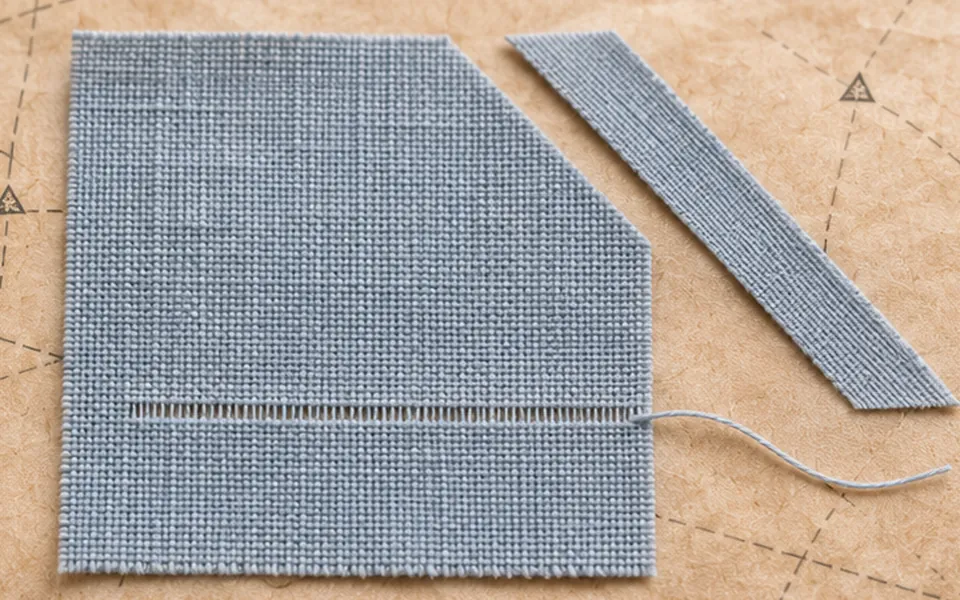
| Pull a thread | Snip about 1/2 in (12 mm) into the edge, ease out one or two crosswise threads and cut along the gap they leave.3 | Most woven cotton, linen and shirting | Slow on wide fabric; if the thread breaks, pick it up from the gap. |
| Tear | Snip into the edge and rip firmly across. The tear follows a single thread. | Firm plain weaves such as quilting cotton and calico | Tearing stretches and ripples the edge; steam-press it flat before measuring.3 Do not tear twills, loose weaves or knits. |
| Stretch test | Pull gently along, across and diagonally. Least give is lengthwise, a little more is crosswise, most is bias.1 | Small scraps and offcuts | On very firm cloth, confirm with a pulled thread. |
| Follow a stripe or check | Use a woven-in stripe or check as your guide line. | Woven ginghams and shirting stripes | Only works if the pattern is woven in, not printed. Prints can sit off grain. |
On a fabric where pulling a thread is awkward, such as a knit, sewers baste (sew long temporary stitches) along a single course instead, or pin along one crosswise yarn and remove the pins as they cut.2
Finding the grain on a finished garment
The lengthwise grain runs vertically toward the hem on most shirts, skirts and trouser legs, and on pressed trousers the front crease usually follows it.
For a firm answer, turn the garment inside out and tease a thread loose from the raw edge of a seam allowance (the strip of fabric between the stitching and the cut edge). Threads that pull out sideways from a vertical edge are crosswise threads, so the lengthwise grain runs along that edge. The stretch test works on a garment too. Ignore the diagonal ribs on denim or gabardine; they cross the threads at an angle.
Off-grain fabric and straightening it
Fabric is off grain when its lengthwise and crosswise threads no longer meet at right angles. To test, straighten one cut end by pulling a thread, then fold the cloth in half lengthwise, matching the selvages and the two halves of the straightened end. If it will not lie flat without a ripple or a twisted fold, the grain is off.3
University of Kentucky Extension puts the work in this order: straighten the cut ends, preshrink, then correct the grain.2 For woven cloth, the correction is to pull the fabric on the true bias, across the short diagonal, while it is slightly damp, then let it dry flat with the threads square.2 Wool can be rolled in a wet sheet for 8 to 12 hours, smoothed square and left to dry, usually overnight.2 Knits are patted into position on grain while damp.2 Pressing with steam helps set the result; see pressing as you sew.
Some fabric will not move. Synthetics and cloth with a heat-set finish often stay off grain however much you pull.2 For a print, the same source suggests cutting along the printed design as a last resort.2 With a plain fabric, cut on the true thread line.
Why patches and repairs must match the grain
A patch sewn with its grain running a different way from the garment behaves like a different fabric. Garment and patch stretch by different amounts, so the stitches take the strain every time you bend a knee, and the edge puckers or the stitches break. A 1943 North Carolina extension bulletin on mending set out the rules: cut the patch along the threads, run its threads the same way as the garment's, use the same material where you can, and wash the patch first if the garment has faded.5 Stripes and plaids should line up as well.5
The same rule applies to darning and tear repairs. A straight tear is darned with small running stitches that follow the fabric's own threads, and a diagonal tear is worked with rows parallel to the lengthwise threads, then a second set at right angles.5 For step-by-step methods, see repairing a tear in woven fabric and sewing a patch by hand.
Worked example: a patch for a trouser knee
A pair of cotton work trousers has a worn hole at the left knee, roughly 1 1/2 in by 2 in (38 by 51 mm). To cut a patch that moves with the leg:
- Trim the hole to a tidy rectangle that follows the threads, about 2 in wide by 2 1/2 in tall (51 by 64 mm). Cut along a single thread on each side so the edges are on grain.
- Add about 1 in (25 mm) on every side for the overlap.5 The patch is 2 + 1 + 1 = 4 in wide and 2 1/2 + 1 + 1 = 4 1/2 in tall (10 by 11.4 cm).
- Find patch fabric. A deep hem allowance inside the same leg gives the closest match. If the trousers have faded, wash the new piece first.5
- Mark the grain. Pull a thread on the patch fabric and draw an arrow on the wrong side along the lengthwise threads.
- Lay the patch under the hole with the arrow pointing straight down the leg, parallel to the threads you identified in the seam allowance.
- Check by stretching. Pinch patch and leg together and tug downward. They should give equally; if the patch stretches more, it is turned or cut on a slant.
On jeans, line up the threads, not the slanting twill ridges. The full denim method is in patching jeans; for decorative options see visible mending.
Bias strips and why they curve
Because cloth gives most on the true bias, a 45 degree strip can be stretched along one edge and eased along the other, so it lies flat round a neckline where a straight-grain strip would ripple. Janome recommends bias binding for curved projects.7 That give also lets a bias strip wrap piping cord more snugly than a straight-grain strip,8 and Kentucky's directions for a Hong Kong seam finish call for bias strips 1 1/4 to 1 1/2 in (32 to 38 mm) wide.8
Fold a square in half from corner to corner and the fold is the true bias.6 For a long strip without many joins, use the continuous method: cut the square on the diagonal, sew the triangles together on their straight-grain edges, mark lines parallel to the bias edge and sew it into a tube with the lines offset by one strip, so a single cut spirals round it.7 Janome's strip-width rules are six times the finished width for double-fold binding, and twice the finished width plus two seam allowances for single-fold.7
Worked example: how much binding from one square
You want single-fold binding that finishes 1/2 in (12 mm) wide, sewn with 1/2 in seam allowances. Strip width = (2 x 1/2) + (2 x 1/2) = 2 in (5 cm).7 You have an 18 in square.
- Area of the square: 18 x 18 = 324 sq in.
- Divide by strip width to get the theoretical length: 324 / 2 = 162 in, which is 4 1/2 yd (about 4.1 m).
- Allow for the seams and the offset ends of the tube. Kentucky Extension's figure for continuous bias is about 7 yd of 1 1/2 in strip from 1/3 yd of fabric.6 The area rule on 45 in (114 cm) cloth would promise 12 x 45 / 1.5 = 360 in, or 10 yd, so the real yield is about 70 percent of the theory. For your square: 162 x 0.70 = about 113 in, or roughly 3 1/8 yd (2.9 m).
Cut separate strips off the same square instead and the longest one is the diagonal, 18 x 1.414 = about 25 1/2 in (65 cm). A 26 in (66 cm) neckline would need joins; the continuous strip covers it with room to spare.
Common mistakes
- Lining a pattern's grain arrow up with the cut end of the fabric. Shop-cut ends are rarely straight. Measure from the selvage instead.
- Tearing a twill or loose weave to straighten it. The tear wanders and pulls threads out of the edge.
- Cutting a repair patch from any spare corner without checking its direction, so it puckers after the first wash.
- Expecting a heat-set polyester to straighten. If damp pulling has not squared it, cut by the thread line.
- Resewing a twisted jeans side seam. The twist is in the cloth, so a straight new seam will be pulled crooked again.
Before you cut anything for a repair, draw a grain arrow on the wrong side of the new piece and check it against the garment.
Sources
- Understanding Fabric Grain (CT-MMB.210), University of Kentucky Cooperative Extension
- Fabric Preparation for Sewing (CT-MMB.211), University of Kentucky Cooperative Extension
- Easy Table Runner, Utah State University Extension
- Method of skewing twill fabric to avoid leg twist (US Patent 3,959,826), Levi Strauss & Co., via Justia Patents
- Make and Repair for Victory (4-H Club Series No. 38), North Carolina Agricultural Extension Service, 1943 (NC State University Libraries)
- Decorative Cording (HF-LRA.079), University of Kentucky Cooperative Extension
- Making a Continuous Bias Binding, Janome
- Seams and Seam Finishes (FCS2-304), University of Kentucky Cooperative Extension
Links were checked when this guide was last reviewed. If one has moved, please let us know. How sources are chosen: editorial policy.